Day Trip to the Yarra Valley From Melbourne: Getting There and Getting Around
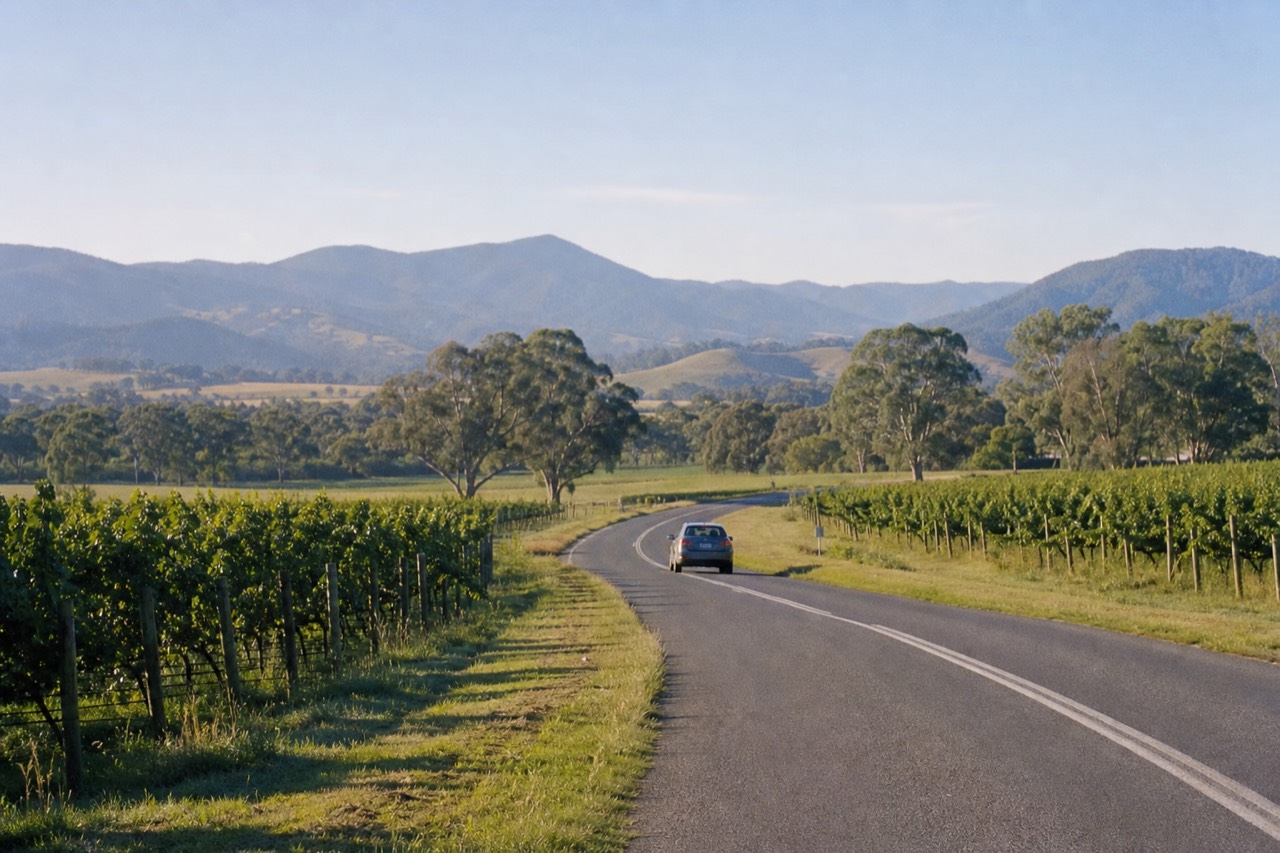
Healesville sits about an hour from the CBD and the valley holds more than 90 cellar doors. The hard part was never the distance. It is who drives home.
Short answer
Yes. The Yarra Valley begins about 55 kilometres north east of Melbourne and Healesville is roughly 65 to 70 kilometres out, an hour by car. Trains and buses reach the towns but not the scattered wineries, and Victoria's 0.05 limit is why most visitors book a guided day instead.
Sixty-five kilometres. That is the gap between Melbourne's CBD and Healesville, and it is the whole reason this trip works. You can leave the city after breakfast, taste at four or five cellar doors, eat lunch looking down a slope of pinot vines, and be back before the evening tram crush. What visitors get wrong is almost never the distance. It is the assumption that a train and a connecting bus will set them down at a winery gate, and the quieter assumption that whoever drives can have a couple of tastings and still be legal on the Maroondah Highway at four in the afternoon.
Neither assumption survives contact with the valley. Here is what actually happens on the road, what each way of getting there costs, and how the day breaks down hour by hour.
Can I take a day trip to the Yarra Valley from Melbourne?
Yes, comfortably. The Yarra Valley starts around 55 kilometres north east of Melbourne's CBD, and Healesville at the far end sits roughly 65 to 70 kilometres out, about an hour of driving in normal traffic. Guided days run around eight hours door to door. No overnight stay is needed to see the region properly.
The valley is a day trip in the truest sense: it is close enough that nobody sensible books a hotel for one night of tasting, and spread out enough that you will see a fraction of it. Visit Yarra Valley counts more than 90 cellar doors across the region, and Wine Yarra Valley puts the number of wineries at over eighty. Four stops is a normal day. Eight stops is an unusually busy one. Twelve is nobody's day, and any itinerary promising it is padding the count with a chocolate shop and a photo stop.
Once you are inside the region the driving shrinks. Yarra Glen, Coldstream, Yering, Dixons Creek and Healesville sit within short hops of each other along the Melba and Maroondah highways, so the second half of the day involves ten and fifteen minute transfers rather than the long run out from the city. That geography is why the eight-hour tour format settled where it did: roughly two hours of the day is the commute at each end, leaving five or six hours in the valley itself.
The realistic question is not whether a day trip is possible. It is how many cellar doors you can visit without the day turning into a queue of tasting benches, which we work through in how many wineries fit into one day. If your appetite is smaller, half-day wine tours from Melbourne leave the rest of the afternoon free.
How far are wineries from Melbourne?
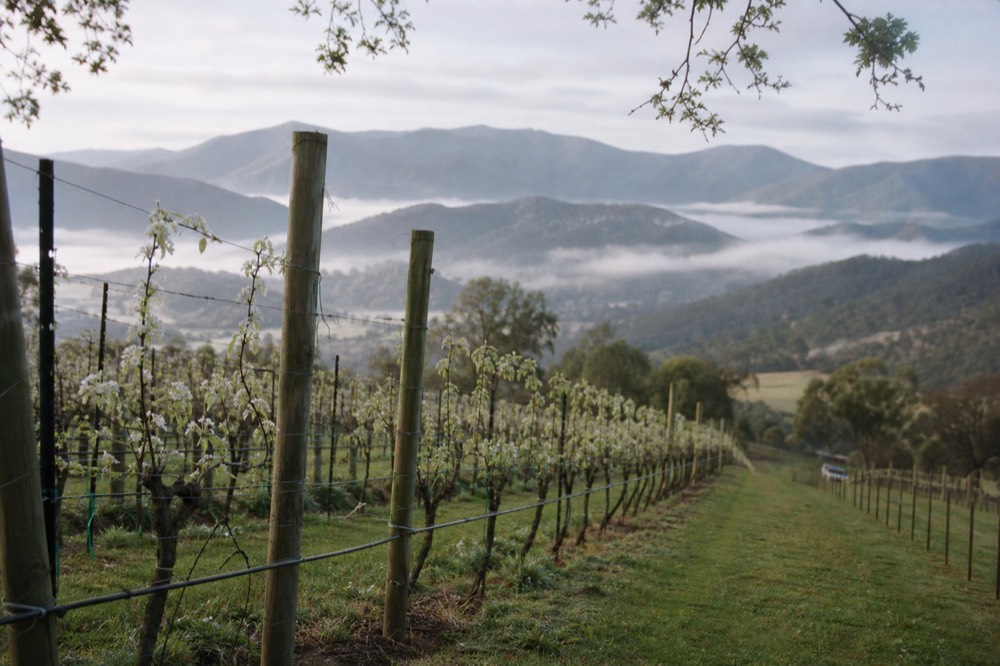
Yarra Glen is about 55 to 60 kilometres from the CBD, a drive of 30 to 60 minutes depending on traffic and which exit you leave the city by. Healesville is 65 to 70 kilometres, usually an hour to an hour and ten. South east, Red Hill on the Mornington Peninsula is 77 to 87 kilometres and about an hour, Sorrento roughly 95 kilometres and an hour twenty.
| Destination | Distance from the CBD | Typical drive | What sits there |
|---|---|---|---|
| Yarra Glen | 55-60 km | 30-60 min | The Chocolaterie, Yering Station and Yarra Valley Dairy cluster nearby |
| Healesville | 65-70 km | 1h to 1h 10m | Four Pillars, Healesville Sanctuary, the eastern end of the valley |
| Red Hill (Mornington Peninsula) | 77-87 km | about 1h | The other direction entirely, south east |
| Sorrento (Mornington Peninsula) | about 95 km | about 1h 20m | The far tip of the peninsula |
Route planners disagree with each other, and the disagreement is instructive. Travel-time calculators put Melbourne to Healesville at 65 to 70 kilometres and a little over an hour, while a ride-hailing route estimator quotes around 41 kilometres and 44 minutes for what it calls the same trip. Both are honest numbers. They just start from different points and pick different roads. Treat an hour as the planning figure from the middle of the city, add twenty minutes if you are leaving between eight and nine on a weekday, and stop worrying about the last five kilometres.
The two big regions are almost equidistant, which surprises people who assume the peninsula is a longer haul. Red Hill and Healesville are both roughly an hour out, in opposite directions. The difference between them is not travel time, it is what waits at the end and how many operators will actually take you there. We break the two apart in the Yarra Valley and Mornington Peninsula compared.
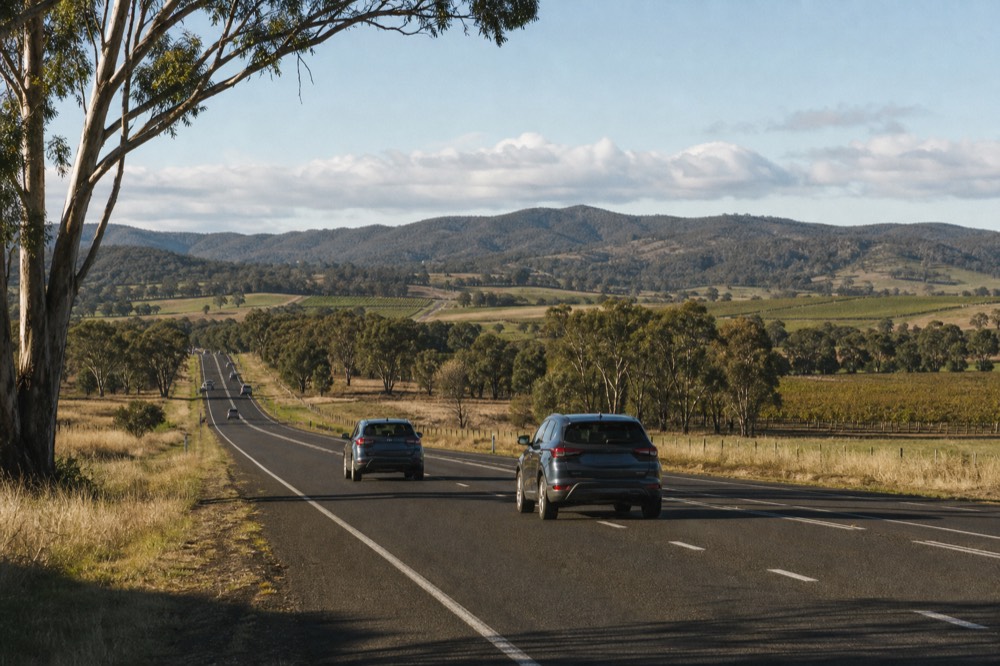
One practical note about the road itself. The last stretch into Healesville runs through the Black Spur country and the highway narrows through towns with 50 and 60 zones. Victoria Police work these roads, and the run home on a Sunday afternoon is a known enforcement stretch. Nothing about the geography is hard. The scrutiny is real.
Can you get to the Yarra Valley on public transport?
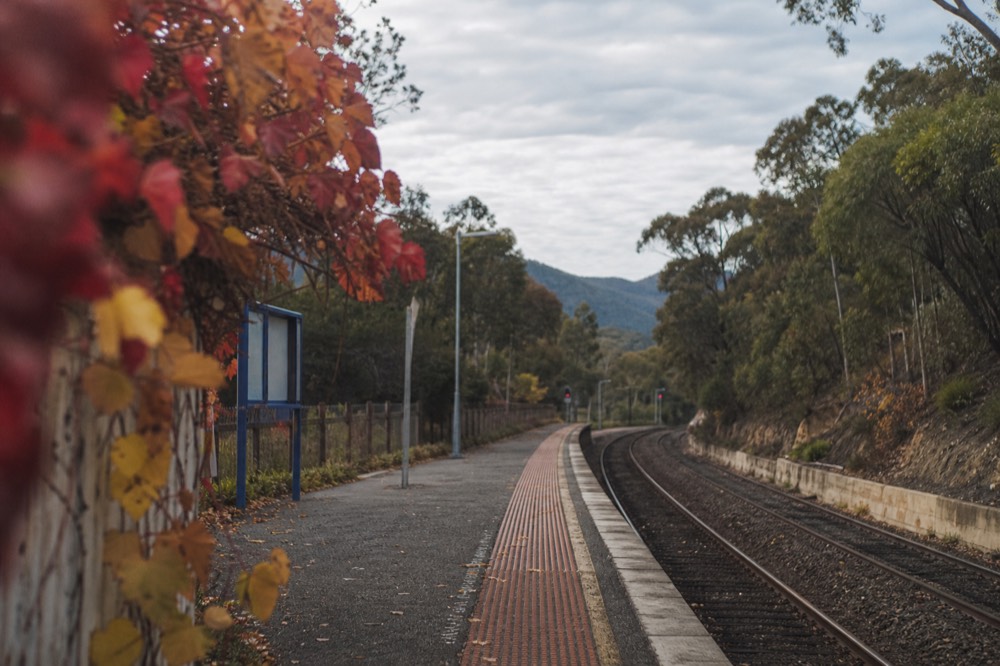
You can reach the towns. You cannot reach the wineries. The Lilydale train line takes you to Lilydale station, McKenzie's buses continue to Yarra Glen and Healesville, and that is where scheduled public transport stops. Cellar doors sit scattered on rural roads between the towns, with no bus running between them.
| Leg | What runs | Where it puts you | What it will not do |
|---|---|---|---|
| CBD to Lilydale | Lilydale line train | Lilydale station, the western edge of the region | No cellar door is a sensible walk from the platform |
| Lilydale to Yarra Glen or Healesville | McKenzie's buses | The town centres | Most wineries are kilometres out of town |
| Between cellar doors | Nothing scheduled | Nowhere | Winery-to-winery movement is entirely on you |
| Belgrave line plus Ventura buses | Olinda, Sassafras, the Dandenongs | A different region, uphill and south | This is not the Yarra Valley wine route |
Both Visit Yarra Valley and Visit Melbourne's regional practical information say the same thing in politer language: direct winery access by public transport is very limited, and buses serve towns and villages rather than the vineyards themselves. That is not a gap in the timetable, it is the shape of the region. A valley with 90-plus cellar doors spread across a hundred square kilometres of farmland cannot be served by a bus route, and nobody has tried.
What this means in practice: a train and bus combination will get two people to Healesville for the price of a couple of myki fares, and then strand them. You could build a day around the handful of things within walking distance of a town centre, and some visitors do, but you will spend the afternoon looking at cellar doors on a map that are twelve minutes away by car and unreachable on foot.
That gap is exactly why the tour market here is as large as it is. Door-to-door pickup from the city is not a luxury add-on in the Yarra Valley, it is the only scheduled transport that goes where the wine is.
How to get around Yarra Valley wineries?
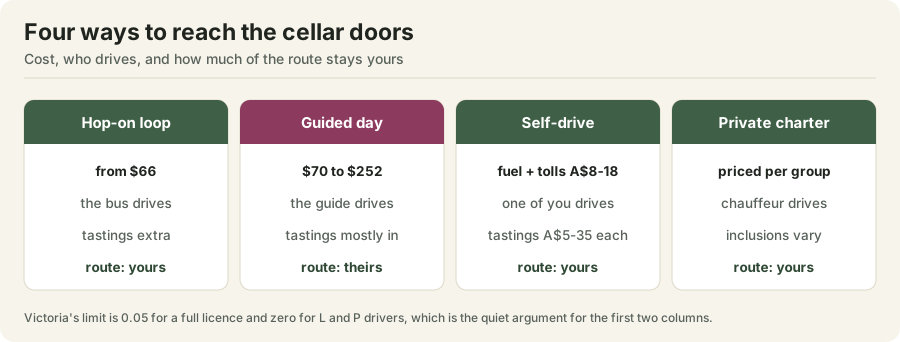
Four options work: a guided small-group day where the operator drives and tastings are usually included, a hop-on hop-off loop bus you ride between cellar doors at your own pace, self-driving with one person staying sober all day, or a private charter. Ride-hailing coverage between rural cellar doors is thin and we would not build a day on it.
| Option | Who drives | Cost per person | Tasting fees | Route control | The catch |
|---|---|---|---|---|---|
| Guided small-group day | The operator | $70 to $252 | Usually included | Fixed itinerary | You take the route as set |
| Hop-on hop-off loop bus | The operator | from $66 | Paid at each door, roughly A$10-15, often waived on purchase | You pick the stops | You wait for the next loop |
| Self-drive | One of you, sober all day | Fuel plus A$8-18 tolls plus fees | A$5 to A$35 per door | Total | One person tastes nothing |
| Private charter | The operator | Priced per group | Varies by inclusion | Total | The highest cost by a distance |
The guided day is the default for a reason. Operators run set routes that string four to eight venues together in an order that works, they carry the tasting fees inside the ticket price on most itineraries, and the vehicle waits while you finish. The trade is control: you go where the bus goes.
The loop bus is the interesting middle. At $66 it is the cheapest way into the valley we can verify, runs a self-paced circuit between cellar doors with city and Lilydale pickups, and carries up to 24 people per bus. Tastings are not included, so you pay A$10 to A$15 at each door, though many wineries waive the fee if you buy a bottle. If you want to spend ninety minutes at one producer instead of the standard forty, the loop is the only format that lets you, and you can check current run days and pricing on the loop's booking page before deciding whether the freedom is worth doing your own maths on fees.
Self-driving is genuinely fine if, and only if, someone has volunteered to be the driver and understands that the job means no wine. Not a taste. Not a sip at the good one. The next section explains why that line is where it is. Parking at valley cellar doors is free and plentiful, the roads are easy, and a car lets you reach the small appointment-only producers no bus visits. It is the right answer for a group of three where one person does not drink anyway. It is the wrong answer for two people who both came for the wine.
Private charters exist and price per group rather than per head, which flips the arithmetic once you are five or six people. A customisable private Yarra Valley day keeps the full route control of self-driving without the sober-driver problem, and details and current pricing live on the booking page.
What does driving yourself actually cost?
Once you add tolls of A$8 to A$18, fuel for a 130 to 140 kilometre round trip, and tasting fees of A$5 to A$35 at each cellar door, a self-drive day for two costs real money and still leaves one person dry. A guided day from $70 per person includes most of that, plus the driving.
| Line item | Self-drive, two people | Guided day, two people |
|---|---|---|
| Tolls (EastLink and CityLink routes) | A$8-18 for the day | Included in the fare |
| Fuel | Your own car, 130-140 km round trip | Included |
| Parking | Free at cellar doors | Included |
| Tasting fees across four doors | A$40 to A$140 combined | Included on most guided itineraries |
| Lunch | Your own, A$25-35 each at a winery restaurant | Included on some tours, own expense on others |
| The driver's share of the wine | Nothing | Full |
| Ticket price | None | From $66 per person on the loop bus, $70 guided, $93 for the market leader |
Tolls are the line people forget. Melbourne's toll roads charge by route and vehicle rather than a flat regional fee, and the general daily range sits between A$8 and A$18 depending on which combination of EastLink and CityLink your route uses and how you pay. There is no fixed Yarra Valley toll. If you leave from the eastern suburbs you may pay nothing at all, and if you cross the city you will pay toward the top of that band.
Tasting fees vary more than most first-timers expect. Yering Station charges A$15 for its village series, A$20 for the Yarrabank and estate flight and A$35 for single vineyard and reserve wines, all negated on purchase. De Bortoli's tasting experience runs around A$20 for up to eight wines. Yarra Valley Dairy asks A$5 for a brief cheese tasting or A$15 for the full range. Four Pillars gin sessions start at A$50 and bookings are essential. Add those up across a real itinerary and the "free" self-drive day has quietly spent A$100 before lunch.
The honest summary is that self-driving saves money for one person and costs one person the wine. If the maths matters to you, the full breakdown of what each format includes sits in what a Yarra Valley tour costs.
Why does Victoria's 0.05 limit settle the argument?
Victoria sets the blood alcohol limit at 0.05 for full licence holders and zero for learner, probationary and certain commercial drivers. A cellar-door day involves four to eight tastings across five hours. There is no version of that where a driver stays reliably under the line, and the penalties for getting it wrong start at a three-month licence cancellation.
| Licence type | Legal blood alcohol limit | What it means on a tasting day |
|---|---|---|
| Full Victorian or overseas full licence | 0.05 | A driver cannot taste through a day and stay confidently under |
| Learner (L plates) | 0.00 | Nothing at all, no exceptions |
| Probationary (P1 and P2) | 0.00 | Nothing at all, no exceptions |
| Certain commercial drivers | 0.00 | Nothing at all, no exceptions |
The Victorian drink-driving rules are not ambiguous and the consequences are heavier than most visitors assume. A first offence typically brings licence cancellation of at least three months, longer at higher readings, a mandatory alcohol interlock fitted for six months or more, a zero-BAC period of three years or more once the disqualification ends, a behaviour change program, and fines calculated in penalty units worth about A$203.51 in 2025-26. For an international visitor, losing a Victorian driving entitlement mid-trip does not just end the wine day.
The zero limit for probationary drivers catches people out constantly. A young Australian on P plates cannot have one tasting pour, and the plate is on the car in the winery car park where everyone can see it. There is no discretion in this and no cellar door will help you argue it.
Cellar door staff are also bound by responsible service rules. The legal drinking age is 18 with no exceptions at licensed venues, valid photo identification is requested from anyone who looks under 25, and staff are obliged to refuse service to anyone showing signs of intoxication. That last one matters on hour six of a big day. Nobody is going to talk their way into a final pour they should not have.
This is the honest engine behind the entire tour market here. Not comfort, not commentary, not the guide's jokes. Somebody has to drive 65 kilometres home, and Victoria has decided it cannot be somebody who spent the afternoon tasting pinot. Every operator you can book from the city is selling a solution to that single problem, and the full Yarra Valley lineup is basically twelve different price points on the same idea.
What does the day look like hour by hour?
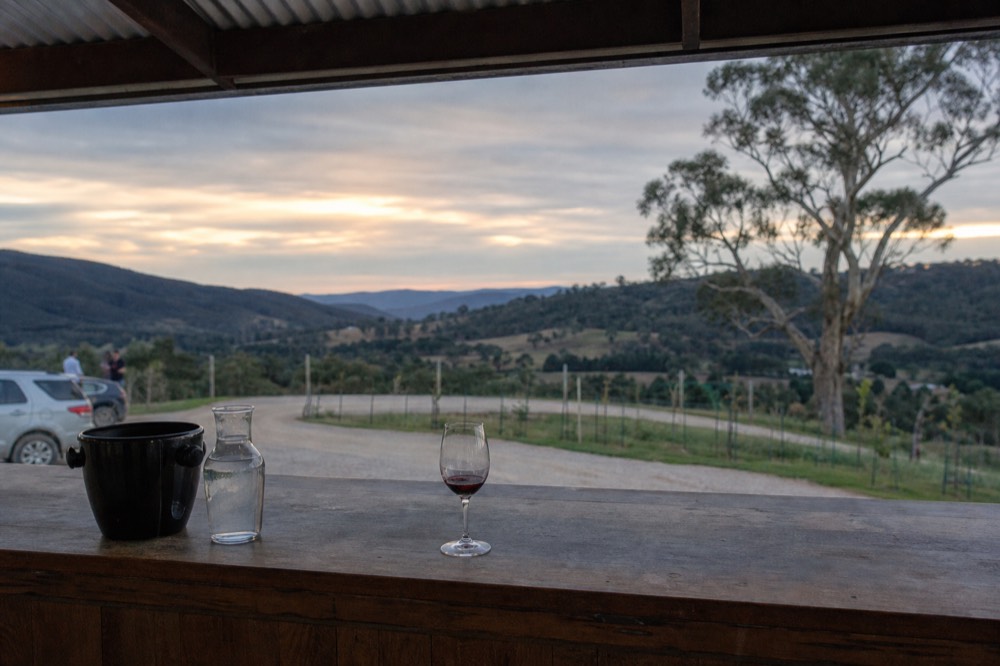
A guided day is around eight hours: city pickup between 8:30 and 9:30, first cellar door before eleven, lunch in the middle, three or four more stops through the afternoon, back in the city between four thirty and six. Self-driving covers the same ground with an extra hour of your own driving and one person permanently sober.
| Time | A typical guided eight-hour day | Driving yourself |
|---|---|---|
| 8:15-9:30 | Pickup at a CBD hotel or a set city point | Load the car, fight the outbound traffic |
| 9:30-10:30 | The run out through Lilydale, guide talks through the region | Same road, one hand on the wheel |
| 10:30-11:30 | First cellar door, fees usually already paid | First cellar door, pay A$15 to A$35 each |
| 11:30-12:30 | Second stop, often a smaller producer | Second stop, plus finding it |
| 12:30-2:00 | Lunch, included on some tours, bought on others | Lunch, and the driver drinks water |
| 2:00-3:30 | Two more stops, gin or cheese or chocolate | Same, watching the clock |
| 3:30-4:30 | Final stop, usually something sweet or savoury | Final stop, then pack the boot |
| 4:30-6:00 | Doze on the way back into the city | An hour of driving in fading light |
Exact times shift by operator. One small-group day leaves the Grand Hyatt at 9:30am, another runs 9am to 4:30pm with a cruise-port pickup for ship passengers, and premium ten-hour itineraries start earlier and finish later. The shape does not change much: two hours of transit, five in the valley, one of slack.
The interesting difference between the two columns is not the schedule. It is the last row. On a guided day the run home is the part where everyone goes quiet, half the bus falls asleep and somebody works out that the bottle they bought at the second stop was the good one. Driving yourself, that same hour is the most demanding driving of the day, done tired, into low sun, on a road that narrows through towns.
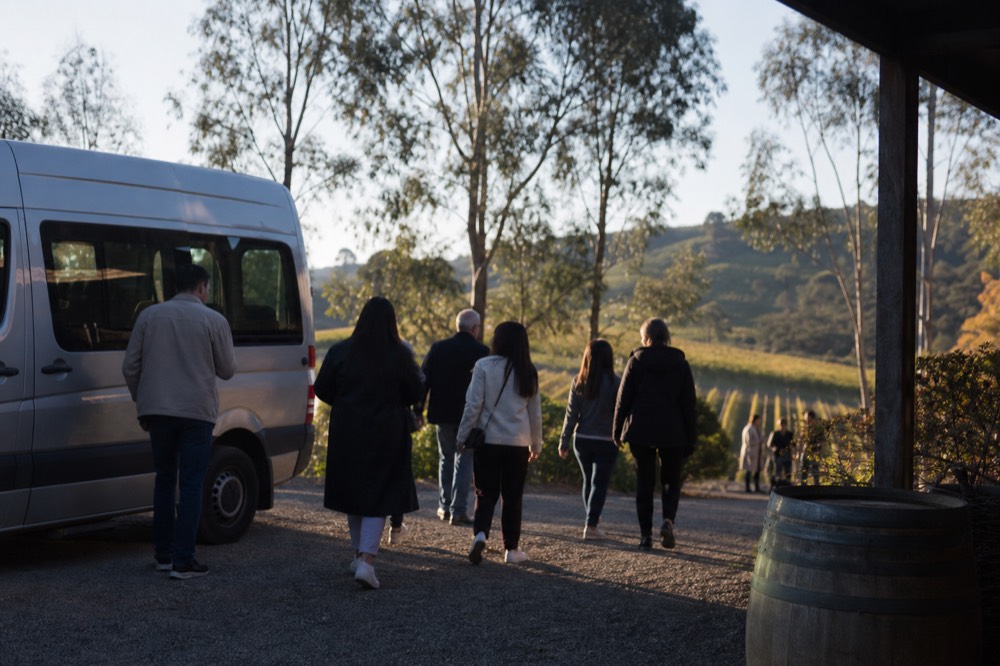
Most eight-hour itineraries cover four to eight venues. If you want the maximum count, the social day that strings together roughly eight stops including gin, cider and chocolate is the one built for it, and you can see the current departure days and price to check it against your dates. If you would rather have four proper sit-down tastings and a real lunch, the all-inclusive coach format suits better.
What else can you fit into a Yarra Valley day?
Plenty, and most of it is cheap. The Chocolaterie is free to enter with tastings from A$4, Yarra Valley Dairy charges A$5 or A$15, Four Pillars gin sessions start at A$50 with bookings essential, and Healesville Sanctuary is from A$58. Puffing Billy is a different region and does not pair with a valley wine day.
| Add-on | Where | Current entry or tasting price | Fits a wine day? |
|---|---|---|---|
| Yarra Valley Chocolaterie | Yarra Glen | Free entry, tastings from A$4, open daily 9am-5pm | Yes, most tours stop here |
| Yarra Valley Dairy | Yering | A$5 brief tasting, A$15 premium range, tastings 10:30am-4:30pm | Yes, an easy mid-morning stop |
| Four Pillars Gin | Healesville | G&T and tasting from A$50, A$30 non-alcoholic, bookings essential | Yes, several tours include it |
| Yering Station cellar door | Yering | A$15, A$20 or A$35 tiers, waived on purchase, 10am-5pm | Yes |
| Healesville Sanctuary | Healesville | Adults from A$58, children 4-15 from A$29 weekdays, open 9am-5pm daily | Yes, on one verified tour |
| Hot-air balloon flight | Coldstream area | Flight only around A$495, with breakfast about A$540, with CBD transfers about A$570 | Sunrise only, before the wine starts |
| Puffing Billy Railway | Belgrave, Dandenong Ranges | Adult A$66, child A$33, family A$165, concession A$52.50 | No, a separate region |
Two of these deserve a straight answer. Healesville Sanctuary is a genuine Zoos Victoria site at the eastern end of the valley, open 9am to 5pm year round, and it slots into a wine day without strain because it is physically in the wine country. One verified tour builds the whole day around it, pairing sanctuary entry with two wineries and a vineyard lunch, and the koala close encounter is an extra of around A$30 on top. If you are travelling with people who do not drink, the wildlife and wine day is the itinerary that gives them something to do besides hold the bags, and you can check what the sanctuary version includes before you compare it with a straight tasting day.
Puffing Billy is the one to be careful about. It is a lovely steam railway, adult fares run A$66 for travel through to March 2027, and it departs from Belgrave in the Dandenong Ranges. That is a different region, reached on a different train line, up in the hills south east of the valley. Plenty of Melbourne itineraries list the two together as though they share a road. They do not, and any plan that puts a morning steam train and an afternoon of Yarra cellar doors in the same day is spending most of it in transit.
Ballooning is the genuine luxury add-on and it happens before the wine, not alongside it. Flights lift off at dawn, the season runs year round with the calmest conditions typically in autumn and spring, and operator pricing sits around A$495 for the flight alone or roughly A$570 with city transfers and breakfast. Book the balloon and a standard tour on the same day and you are awake at 4am, which is a choice.
When is the best time of year to make the trip?
Autumn, March to May, is the strongest all-rounder: harvest runs February to April, the presses are working, vine leaves turn, and balloon mornings are usually calmest. Winter is quiet and foggy, spring is green and building toward peak, and summer brings the crowds along with Victoria's historic bushfire smoke risk.
| Season | Months | What is happening in the valley | What to plan around |
|---|---|---|---|
| Summer | Dec-Feb | Peak visitor season, long evenings, busy cellar doors | Heat, and a summer bushfire smoke risk that Victoria has lived with historically |
| Autumn | Mar-May | Harvest February to April, fruit coming in, vines colouring | The most popular window, so book earlier |
| Winter | Jun-Aug | Quietest doors, fires lit, easiest bookings | Valley fog and morning frost, shorter tasting hours in places |
| Spring | Sep-Nov | Budburst, green cover crops, calm balloon mornings | Prices and demand climbing toward summer |
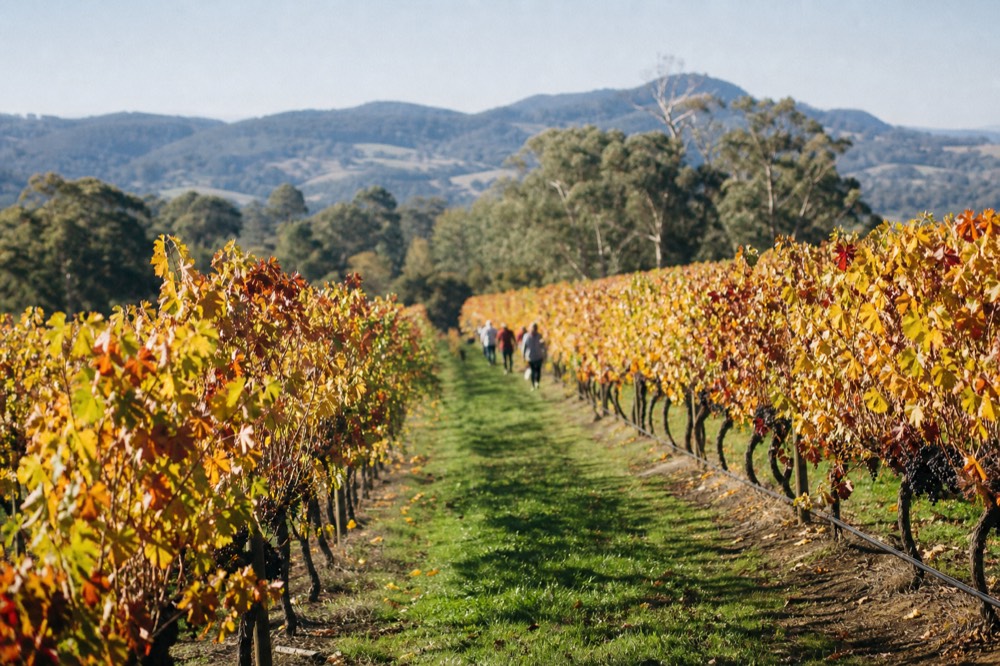
Harvest is the season people ask about and it is worth understanding what it does and does not give you. Between February and April the wineries are working, which means machinery in the yard, fruit bins moving, and staff who are genuinely busy. Cellar doors stay open and the atmosphere is at its best, but the winemaker who might have chatted in July is on the crush pad in March.
The 2026 vintage is a specific story rather than a general one. Victoria's crush fell 31% against the ten-year average, the national harvest was the smallest since 2000, and the season ran early on the back of a warm winter and spring with heat events through the ripening window. Low yields with concentrated, disease-free fruit is a winemaker's consolation prize, and it means the 2026 wines you eventually taste will be scarce and good rather than plentiful. Nothing about that changes a tasting day in 2026, since you are drinking older vintages, but it is the thing cellar door staff will be talking about.
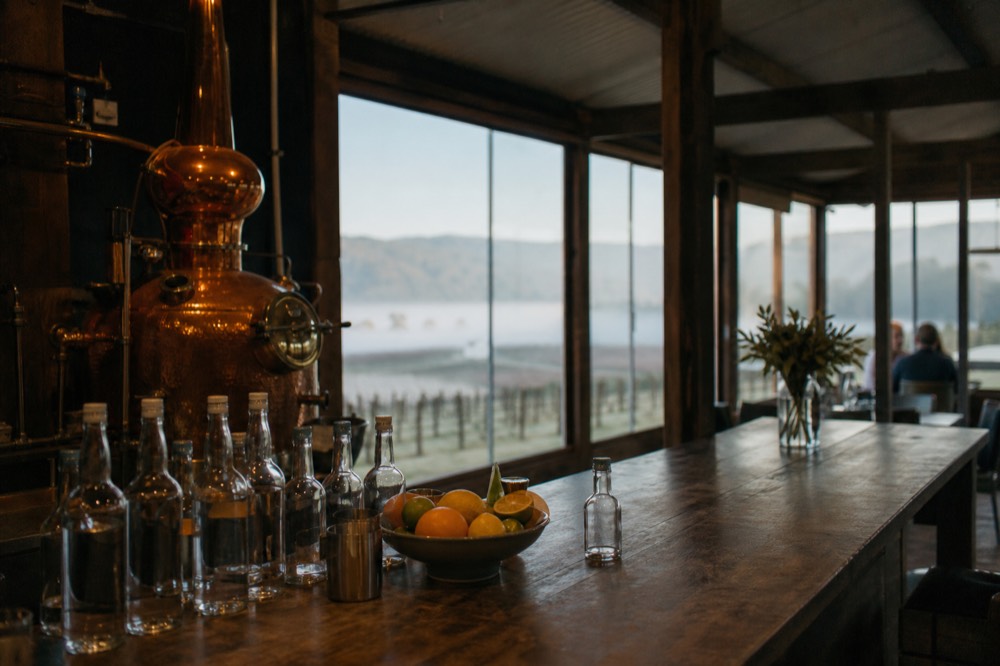
Winter is undersold. Fog sitting in the valley at nine in the morning is genuinely beautiful, tasting rooms are half empty, and the same tour that needs booking three weeks ahead in November often has seats on a Tuesday in July. If your priority is unhurried time with the person pouring, June to August is the value window. Seasonal trade-offs in more detail sit in the best time of year for a wine tour, and if you would rather choose by producer than by month, start with the cellar doors worth your day.
Frequently asked questions
How long is the drive from Melbourne to the Yarra Valley?
About 30 to 60 minutes to Yarra Glen at the western edge and roughly an hour to an hour and ten to Healesville at the eastern end, covering 55 to 70 kilometres from the CBD. Add twenty minutes if you leave the city between eight and nine on a weekday.
Can you visit the Yarra Valley without a car?
Only with an organised tour or the hop-on hop-off loop bus. The Lilydale train line and McKenzie's buses reach Lilydale, Yarra Glen and Healesville, but cellar doors sit on rural roads between those towns with no scheduled service running between them.
Are there tolls on the way to the Yarra Valley?
Possibly, depending on your route. Trips crossing the city may use CityLink or EastLink, and Melbourne's general daily toll range runs about A$8 to A$18 by route, vehicle and payment method. There is no fixed Yarra Valley toll, and leaving from the eastern suburbs you may pay nothing.
Can a designated driver still taste a little?
A full licence holder is capped at 0.05 and learner, probationary and certain commercial drivers are at zero, so the honest answer for anyone on L or P plates is no. For a full licence holder, four to eight tastings across five hours is not a day that keeps you reliably under the limit.
Do you tip a Yarra Valley tour guide?
No. Australia is a no-tip culture for tour guides and cellar door staff. Tipping is not normal nor required and nobody will expect it. If a guide made your day, a review or a word to the operator is worth more than cash.
Can you do the Yarra Valley and Puffing Billy in one day?
Not sensibly. Puffing Billy runs from Belgrave in the Dandenong Ranges, a separate region south east of the wine country, on a different train line. Combining the two means most of the day in transit and very little of either.