What Not to Do at a Wine Tasting?
The etiquette that actually applies at Australian cellar doors: perfume, pacing, spitting, the pours staff are legally obliged to refuse, and why nobody tips.
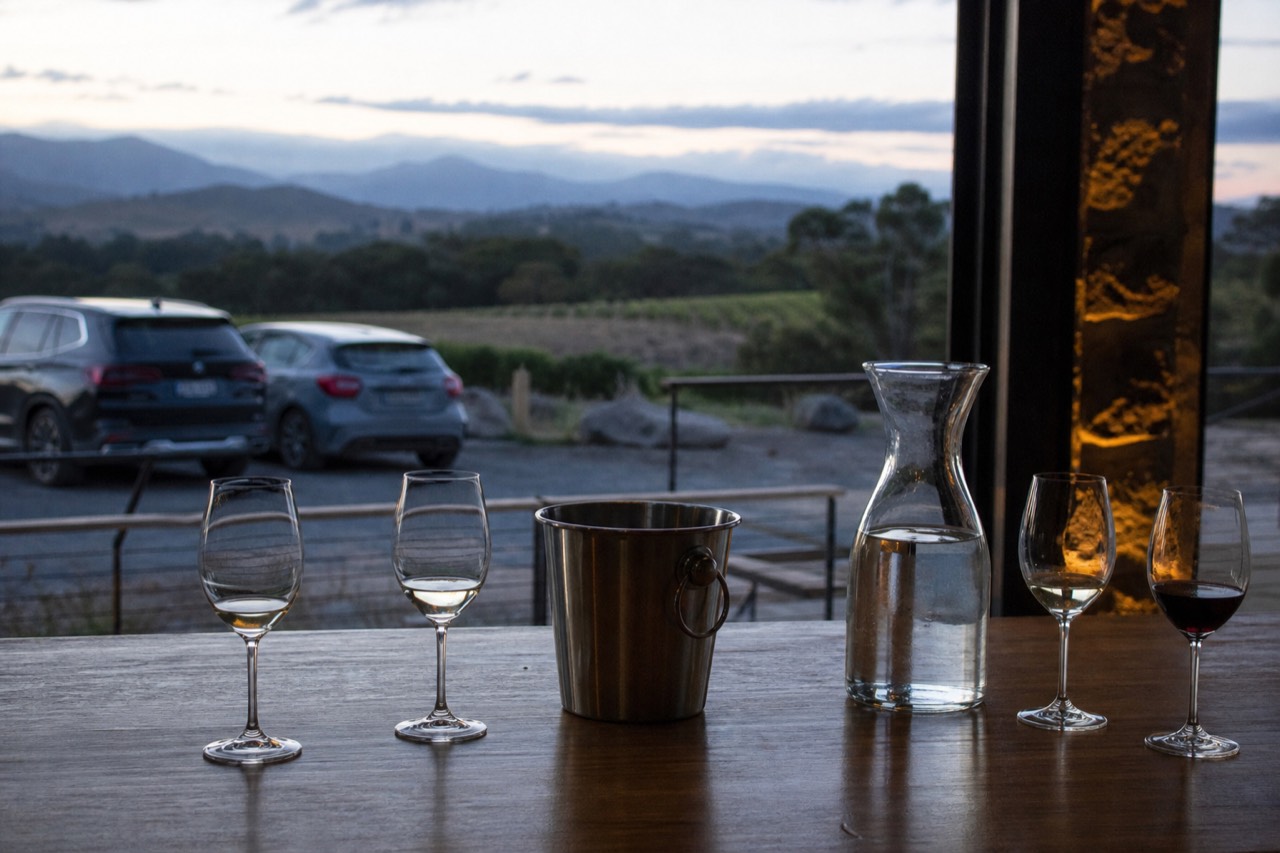
The stainless bucket at the end of the tasting bench is not decoration and it is not the bin. Half the people who walk up to a Yarra Valley counter for the first time will not use it once all day, which is the single decision that shapes how the rest of their afternoon goes.
Cellar-door etiquette in Australia is looser than most visitors expect, and stricter in two specific places that surprise them. Both of those places are law, not manners.
What is the biggest mistake people make at a wine tasting?
Treating pour one of forty as a drink rather than a taste. A standard cellar-door flight runs four to eight wines, and a full-day tour visits four to eight venues. Finish everything poured at the first stop and the fourth stop stops registering, which is the exact outcome you paid to avoid.
Do the arithmetic once and it changes your behaviour. De Bortoli pours up to eight wines in a single tasting for about A$20. Yering Station runs three tiers of flight. String four venues together and you are looking at twenty to thirty pours across roughly six hours, with a lunch somewhere in the middle. Nobody's palate survives that at full volume, and nobody's memory does either.
The fix is unglamorous. Drink water at every stop, eat properly rather than picking, and pour out what you have finished assessing. Cellar-door staff expect all three and none of it reads as rude.
The second common error is going fast at the wrong end. Flights build, so the best wines come last. Empty your glass on the entry-level white and you reach the reserve pinot with nothing left to notice it with.
| What not to do | Why it lands badly | What to do instead |
|---|---|---|
| Wear strong perfume or aftershave | Tasting is mostly aroma; scent at a shared bench affects every glass near it | Skip it entirely on a tasting day |
| Drink every pour in full | Twenty to thirty pours across a day is not a drinking pace | Taste, assess, tip the rest into the bucket |
| Treat the spit bucket as a bin | Staff empty and reuse it; food scraps and napkins are the problem | Wine and water only |
| Push for another pour after staff stop | Refusal is a legal duty on them, not a personal call | Move on, order food, come back later |
| Hand over a tip | Not the Australian norm; it lands as awkward, not generous | Buy a bottle or leave a review |
| Announce that a wine is bad | The person pouring often helped make it | Say what you do and do not like, plainly |
| Take a call at the bench | The bench is a shared, quiet space | Step outside, the vineyard view is better anyway |
| Arrive without ID looking young | Photo ID is required if you appear under 25 | Carry it, always |
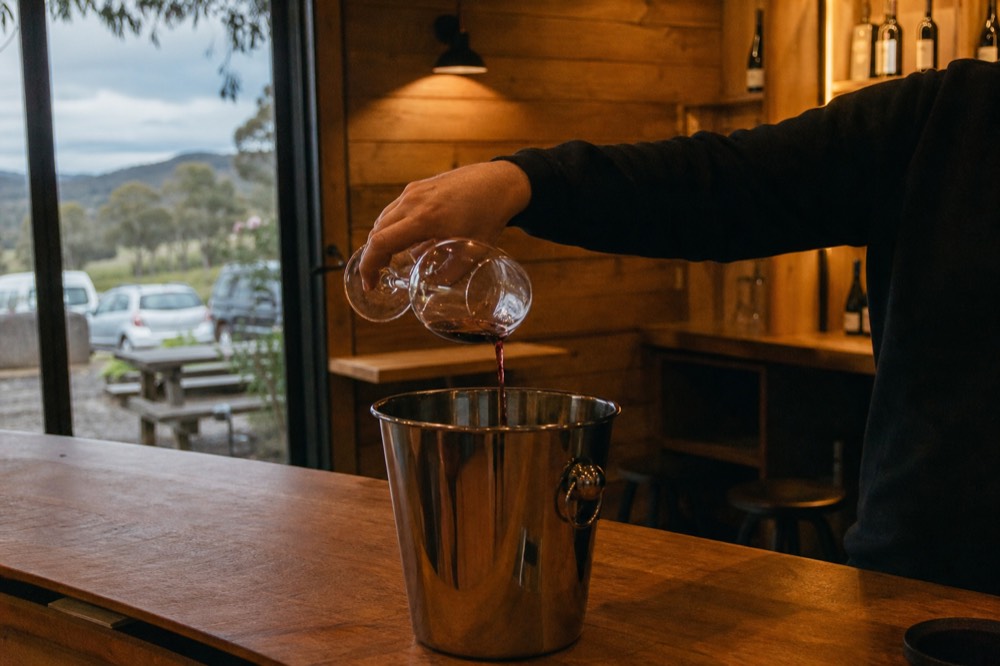
Is it rude to spit wine at a cellar door?
No. It is the professional default and staff read it as competence, not rejection. Everyone whose job involves assessing wine spits, all day, every day. On a tour visiting four to eight venues, spitting is the only way to still have a functioning palate at the last one.
The awkwardness is entirely in the visitor's head. Nobody at the counter is offended, nobody is counting, and no one will comment. What staff notice is the opposite behaviour: a group emptying every glass at 10:30am, because they know how the day ends for them.
Use the bucket properly: stand close and aim low. If spitting genuinely does not appeal, pour the remainder out instead. Same result, none of the theatre, and completely normal at an Australian cellar door.
There is a version of this that matters more than etiquette. Under Victorian law the full-licence blood alcohol limit is 0.05 and it is zero for learner and probationary drivers, so anyone driving is not tasting in any meaningful sense. The Victorian road safety rules set that out, and it is the reason the tour market exists at all. A day where nobody has to make that calculation is worth the seat price on its own, and the twelve-guest premium day through De Bortoli, Yering Station, Payten & Jones and Medhurst is built for exactly that kind of unhurried tasting: you can check the current price and dates if the wine is the whole point.
Can a cellar door refuse to serve you another pour?
Yes, and they are legally required to. Victoria's Responsible Service of Alcohol rules oblige staff to refuse service to anyone intoxicated or underage. The legal drinking age is 18 with no exceptions at licensed venues, and photo ID showing date of birth is required from anyone who appears under 25.
This is the rule most visitors misread. When a counter stops pouring, the reaction is often that the staff member is being difficult. They are not exercising an opinion. Refusal is mandatory where intoxication or an age question exists, and the licence sitting behind the counter is what they are protecting.
Arguing achieves nothing and is remembered. Ordering food, drinking water and coming back in an hour usually does. On a guided day, the guide will generally have read the room before the counter does, and a good one manages pacing without anybody noticing it happened.
The ID rule catches people out because they think it applies to teenagers. It applies to anyone who looks under 25, which in practice means a lot of people in their late twenties get asked. Carry a driver licence, passport or proof-of-age card. A photo of one on your phone is not the same thing.
| Requirement | The rule | Who it affects |
|---|---|---|
| Legal drinking age | 18, no exceptions at licensed venues | Everyone |
| Photo ID | Required if you appear under 25, must show date of birth | Anyone who looks young |
| Intoxicated guests | Staff must refuse service | Everyone, all venues |
| Driving after tasting | 0.05 BAC full licence, zero for learner and probationary drivers | Any self-drive group |
| Small-group day with lunch, capped at 11 | 18 and over only | Anyone booking with teenagers |
| All-inclusive coach | Minimum age 5 | Families with young children |
| Eight-stop social day | Children ride at full adult price | Families weighing the cost |
| Wildlife and wine flagship | No infants | Parents with a baby |
What should you never do with money at an Australian cellar door?
Do not tip. Australia runs a no-tip culture for cellar doors and tour guides alike, and one Australian wine-region operator states it plainly: tipping is not normal nor required, and if you want to do it anyway that is entirely up to you. Buying a bottle is the local equivalent of a good tip.
The awkwardness is real for visitors from the United States, where a tasting-room tip is standard. Here it produces a small, confused pause. Staff are on award wages, the tasting fee is already the fee, and the transaction is complete when you pay it.
What does register is a purchase. Most Yarra cellar doors waive the tasting fee against a bottle, so buying something you liked costs you very little more than the fee you already paid and means considerably more to a small producer than cash across the bench. A named review afterwards is the other thing operators actually ask for. The full picture, including the one grey zone where an optional tip is not strange, sits in tipping on Australian wine tours.
The other money mistake is assuming the fee is a con. It is not. Fees run A$5 to A$35 depending on the flight, they cover the wine in your glass, and the waiver on purchase makes them close to free for anyone buying a bottle.
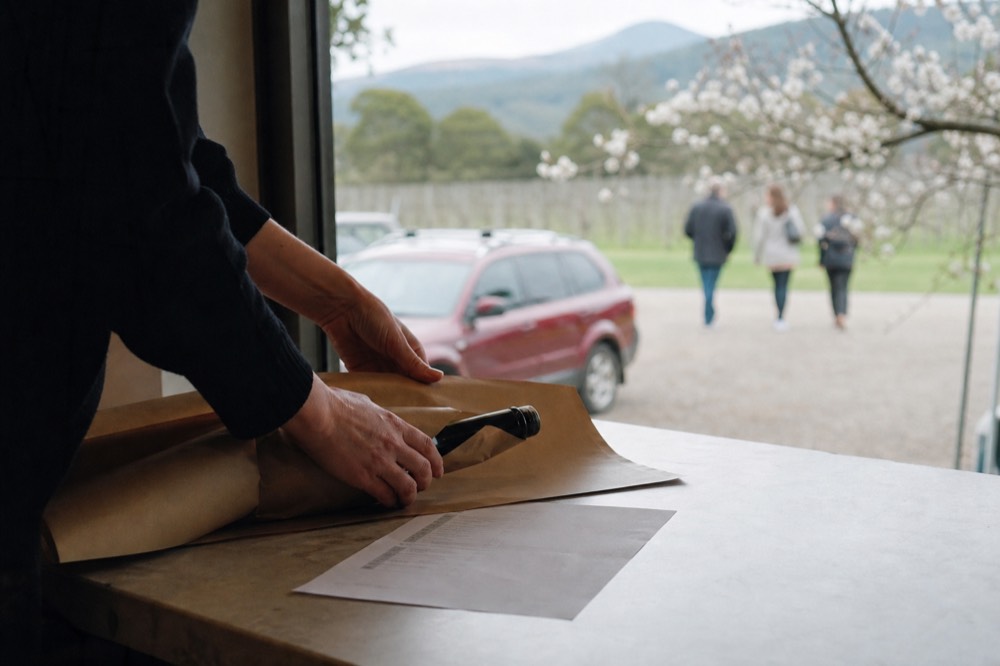
What should you not say or carry to the tasting bench?
Do not announce that a wine is bad, do not take calls at the counter, and do not turn up drenched in scent. The person pouring frequently helped pick or make what is in your glass, and a shared bench is a small, quiet, aroma-sensitive space.
Disliking a wine is completely fine and staff would rather hear it than watch you be polite. There is a difference between telling the host that something is too oaky for your taste and asking what else they have open, and delivering a loud verdict to your friends across the counter. The first gets you a better next pour. The second just makes the room smaller.
Scent is the etiquette rule with the most practical bite, and the one most people have never heard. Perfume and aftershave are discouraged at tasting counters across Australian wine regions because assessment is mostly nose. One strongly scented person at a bench for six affects everyone. It sits alongside the what to wear question, where the answer on jeans is a straightforward yes and the answer on fragrance is a straightforward no.
Phones round it out. Photos are welcome everywhere; a ten-minute call at the bench is not.
How does booking a tour solve most of this?
It removes the two hardest problems: pacing and driving. A guide sets the rhythm across the day, lunch lands where it should rather than where you remember it, and no one in the group is doing sums about their blood alcohol on the drive home.
Watch what a well-run day does. Stops are booked, so nobody stands at a closed door. Lunch lands mid-day, the single biggest factor in whether stop four is enjoyable. Group caps across this market run from six guests up to twenty-four, so the vehicle is rarely overwhelming a counter built for eight.
The premium and lunch-inclusive days go further. A two-course winery lunch with wine already counted in means nobody skips eating to save money, which is the most common self-inflicted wound of a self-driven wine day. The Dancing Kangaroo day, capped at twenty with Yering Station, Helen & Joey, a premium two-course lunch and an unusual option to swap a winery for gin or beer, is a good example of a day designed around pacing rather than volume, and you can see the current price and what dates are open.
None of this makes etiquette irrelevant. You still carry ID, still skip the perfume, still use the bucket. But the errors that ruin a wine day are mostly logistical, and logistics are precisely what you are buying. The full Yarra Valley tour lineup shows which days include lunch and which leave you to it, and the wine experiences page covers the gin, cheese and wildlife variants. If you would rather understand the region before the etiquette, Wine Yarra Valley is the producers' own body.